Pilbara, Western Australia
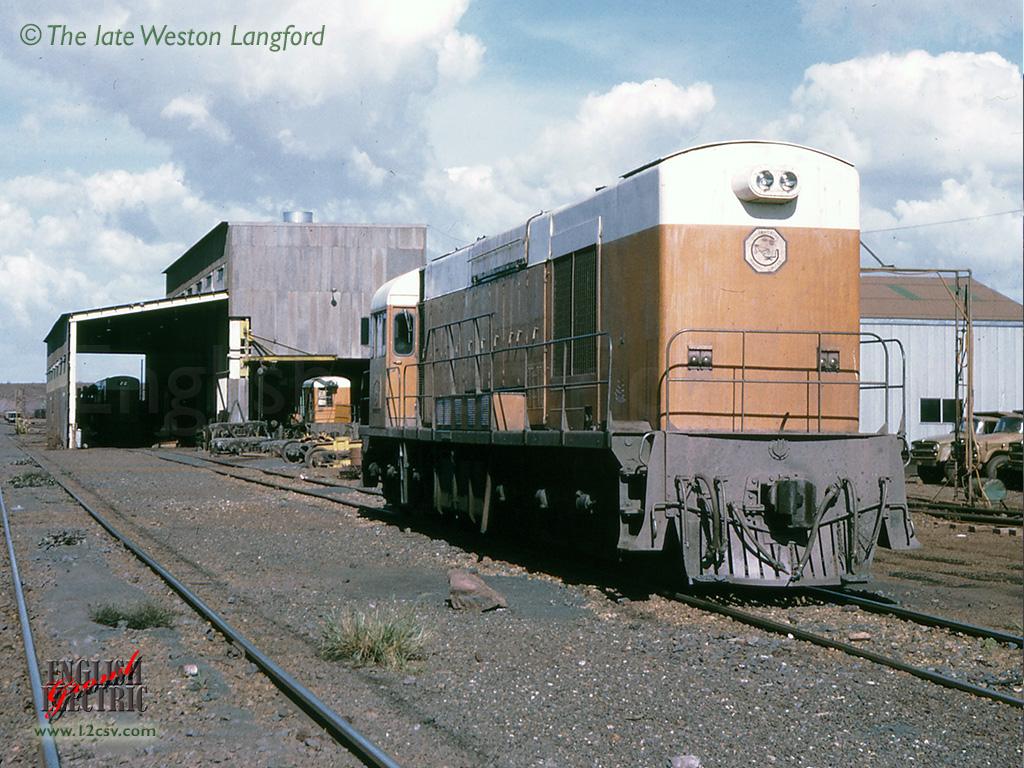
Goldsworthy 'A' Class locos 5 and 6, approach the mining town of Goldsworthy with an 80 wagon, 8000 tonne ore train from Shay Gap in June 1992.
© Bill Parkinson Collection
| The history of the K and A class locomotives can be described as 'eventful', being split into five distinctive batches. The first batch of three locomotives were delivered to the Western Australian Government Railways [WAGR], these were known as the 'K' class and were reported to have been the first locomotives delivered across the width of Australia solely by rail. K201, K202 and K203 arrived in WA during the first quarter of 1966. After the initial trials with these locomotives, WAGR requested modifications to the next batch of 6 locomotives. The first of these series two machines were delivered towards the end of 1966. At the same time as the second batch of K's for WAGR, Goldsworthy Mining Limited ordered 3 locomotives for use on their private line that operated between Shay Gap and Port Hedland. These became known as the 'A' class, but were built to the same specifications as the early batch of K's, now known as series 1 machines. The first member of the A Class arrived late in 1966, traveling to WA in the company of WAGR K, K206. After trails on the GML lines, it was joined by No's 4 and 5 in March 1967, two months after the 'last' K had been delivered to WAGR. Early in 1968, two locomotives of the Goldsworthy fleet were involved in an accident near Finucane Island, No.3 and No.1 were derailed suffering serious damage. No.3 was out of service for over 5 months while it was rebuilt by the staff of GML. Only the Cab, frame and bogies remained from the original loco, all other parts were supplied new by English Electric at Rocklea. Although not 12CSVT fitted, the outcome of No.1 is worth a mention. The frame was deemed beyond repair, so a 'new' locomotive frame and body was built at Rocklea and transported to Goldsworthy where it was fitted out with the parts recovered from the original No.1, GML decided to number this 'new' locomotive No.1 too. GML were now suffering a motive power shortage, with two locos sidelined for an unspecified time. To resolve this shortage an agreement was made between GML and WAGR, for WAGR to supply one of their operational series 1 K's in return for GML ordering a replacement loco of the same design to series 2 specifications from English Electric. K202 moved north in March 1968 and became GML6, with the new loco, K210 being delivered to WAGR from EE a year later, in March 1969. The final batch of locomotives were ordered by GML in 1971, built to series 1 specifications as their previous models, GML7 and GML8 arrived in Western Australia in March 1972, increasing the A Class fleet to 6 examples. The nine remaining K's with WAGR were put to use across the expanding standard gauge network[SGN] of WAGR, they were even helping out as part of the expansion, operating on engineering trains. As the SGN expanded, so did the range of work for the class, including iron ore, nickel, fuel and general goods train over the eastern, Esperance, Leonara and Redmine lines, as well as passenger trains like the 'Indian Pacific' and 'Trans-Australian'. Over time the class settled down to operate out of four main depots, Forrestfield (Perth), Avon (Northam), West Merredin and West Kalgoorlie. At the end of 1985, GML were still expanding and required a spare locomotive to enable them to increase the number of trains operating. As English Electric were no longer producing locomotives and they wanted a similar design to fit in with their operational fleet, WESTRAIL, the operational name of WAGR at the time, was approached to see if they could make another of the Series 1 K's, K201 or K203, available to them. The outcome was that in March 1986, K203 left Perth by road en route to Goldsworthy, where it became GML9. As these classes entered the 1990's, Westrail owned 8 and Goldsworthy owned 7 locomotives. Early in 1992 the whole of the Goldsworthy Mining Limited company was taken over by the Iron Ore section of the Broken Hill Propriety [BHP]. The ageing A class fleet of locomotives was deemed surplus to requirements, replacements were sourced and all locomotives of the A class were 'put up for sale'. Another chapter of the 'A' class locomotives began in June 1992, when another section of BHP, the former AIS works in Port Kembla NSW, was looking for additional motive power. It assessed the A's and 6 of the seven were sold and move to Port Kembla by ship. GML4 which remained, was heavily stripped prior to this assessment and was deemed to far gone to rebuild. It remains were not scrapped however, the carcass of the loco was disposed of in a landfill site at Goldsworthy, at the same time the mining town was demolished and eradicated from the map. On arrival at Port Kembla, further assessments were made on the locomotives and it was intended to return all six back to use. The company already had a number of English Electric locomotives, including D34 which was 12CSVT fitted, the highest number was D45. As a result of this the six 'new' locomotives were allocated the numbers D46 to D51, not in order of their GML numbers because the two ex-WAGR/Westrail K's were grouped together at the end of the list. Early in 1993, D51 (ex A Class GML9/K203) was back in traffic and being used for crew training/evaluation purposes in March. It had been overhauled and returned to use by the BHP Rail workshops at Steelhaven. D50 (ex GML6/K202) was the next to re-enter service in June 1993. The overhaul of D47 (ex GML5) was also carried out at Steelhaven, whilst D49 (ex GML8) was sent to Chullora for the same work to be carried out. At the end of 1993, D46 (ex GML3) and D48 (ex GML7) were still stored at Steelhaven awaiting attention, of note the engine from D46 had been removed and fitted to D51 in the September. During 1994, D47 was reinstated in February joining D50 and D51 as regulars of the BHP fleet with D34. D49 remained at Chullora throughout the year, arriving back at Steelhaven in December, after BHP Fitters had been sent to Chullora to speed up slow progress. D48 also received attention during the year, which included the fuel systems/tanks being flushed and the engine started, although considerable attention was required, not as much as D46 though which was now a forlorn shell at the back of Steelhaven shops. 1995 began with 3 operational K's at BHP, with the rebuild of D49 continuing through the year, work on D46 and D48 had now been abandoned for the time being. As the year drew to a close, a collision between D42 and D50 at the Coal Handling area at Port Kembla, led to D50 being withdrawn, thus reducing the fleet to two again. D49 eventually returned to traffic in May 1996, painted in High visibility BHP Yellow livery. The fleet remained at 3 for the remainder of the time the K's were owned by BHP, D46 and D50 were used as a constant source of spares as they were required. The three K's at Port Kembla soldiered on until 2002, not without giving the maintenance crews some headaches, until they were finally withdrawn by BHP. This was not the end of their story though, they and the 3 stored K's at Steelhaven were bought by South Spur Rail. D46 and D50 were stripped of their remaining useful 'parts' and scrapped on site, D48 was transferred west to the Midland workshops of SSRS, whilst the 3 runners were 'overhauled' at Steelhaven and have been used by SSRS in New South Wales and Western Australia, at the beginning of 2008, all were still in use. The story of D48 is something to believe, having not turned a wheel in anger whilst at Port Kembla, it had been heavily vandalised and deteriorated whilst stored out the back at Steelhaven since BHP's early attempts to reinstate it had failed. On arrival at Midland a full overhaul, including an electrical rewire that makes it different to a standard K, took place and it was returned to use with SSRS late in 2006 carrying the maroon and cream livery of the 'Spirit of the West' dining train. A more detailed history of the WAGR K's will be incorporated into this page in future updates. |
Once you have visited these pages, if you think you can add or correct any of the information on show, please use the links on the contact page to let us know. |
