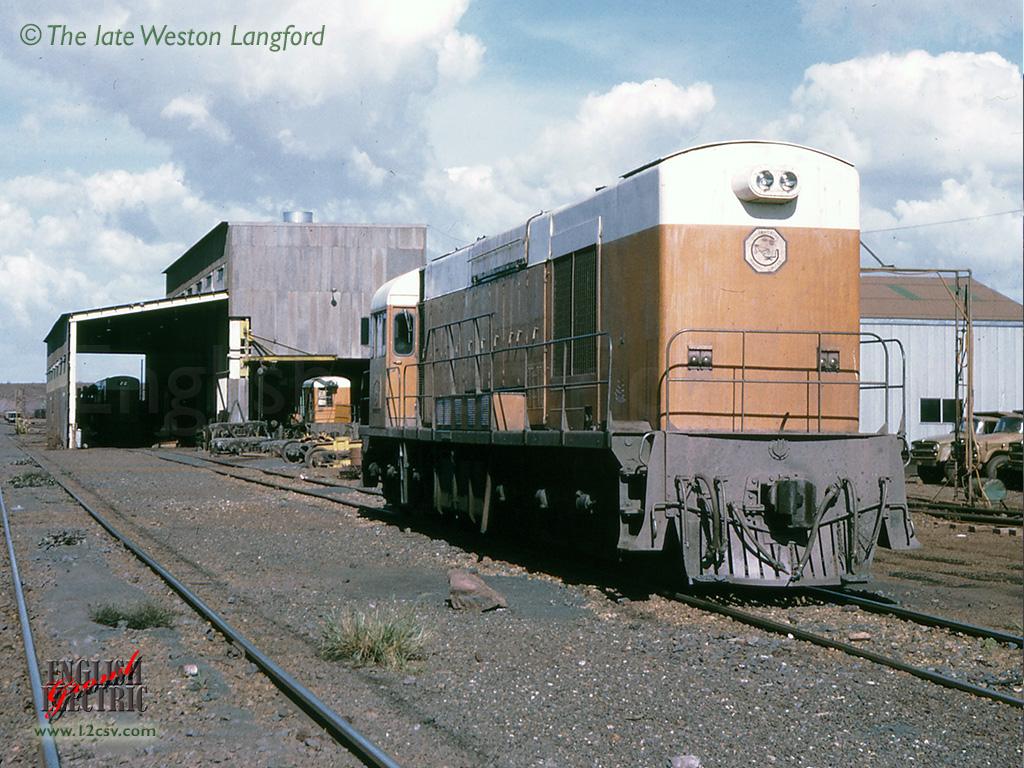
Morogoro, Tanzania
After the break up of the East African railway company in the 1970's, the locomotives remained in the country they resided at that time. During 1988, Tanzania used GEC Traction to refurbish some of it's 87 class. Here 8730, is seen outside the Morogoro workshops in 1988.
© Martin Frodsham
| The "English Electric Company" was formed in 1919 and was taken over by GEC in 1969, with the EE name being made redundant in 1972. Although it was only in production for just over 50 years, the name and trains will live on in some format for a considerable time, as the company became one of the most successful locomotive builders of the 20th century, not only in the UK, but around the globe. This was not the first use of the name though, the "English Electric Manufacturing Company Ltd" was formed in November 1899, by some of the board members of two renowned companies already in production at Preston, Dick, Kerr & Co. and the Electric Railway & Tramway Manufacturing Company. This use of the name was only to last four years, before it was amalgamated fully into the Dick, Kerr & Co. Dick, Kerr & Co., Willans & Robinson, the Phoenix Dynamo Manufacturing Company, the Coventry Ordnance Works and Siemens Bro's. merged together in 1919 become the "English Electric Company". Four of the companies that merged were under the control of John Brown & Co, who had earlier made inroads into the production of the metal rails for use on the railways, but a company that became more known for shipbuilding in Glasgow. It is surprising to find out that even though the company had the ability to build locomotives and motor coaches "in house", some parts were still sourced from other companies. This continued throughout the 1920's, where most orders were not for the home market, but for export. The late 1920's the company went through lean period,like most other companies of the time. In the 1930's, EE was quite a success, even though an early experimental design for a Diesel Rail-car was not successful in the UK due to lack of need for this type of transport! Around the same time though, a 6-cylinder engine was built at the Willans & Robinson Rugby works, which was fitted to a 0-6-0 Diesel prototype shunter designed by EE, fitted with EE electrical equipment, but the mechanical parts were built by another external company, Hawthorne & Leslie. Apart from the Diesel shunters, it was still hard to get Diesels accepted into the Home market, most of EE successes throughout the remainder of the 1930's, were due to the high number of exports to colonies of the commonwealth, both Diesel and Electric. The only break in production being caused by the 1939 to 1945 conflict, were alternative uses were made of the equipment on the productions lines, including a diversion into aircraft production at the request of the then government. During the latter years of the war, two companies became a part of English Electric. D. Napier had made itself known in the world of marine propulsion and, Marconi, a name synonymous with the communications industry. After the war, the railway companies of the UK, were seeking ways to modernise the railways, the GWR (Western region) went down the gas turbine route, whereas the LMS (Midland) and SR (Southern) went for Diesel. EE had a major influence on both the latter. The biggest influence on the Home market was to come in the 1950's, the company expanded in size when the Vulcan Foundry, which had bought out the Robert Stephenson & Hawthorn company in 1944, became part of the English Electric Group, creating the principle supplier in the UK and a strong supplier to export, especially Australia, New Zealand, Asia and a number of African countries. During the early 1950's, the company realised the scope of the business available in the southern hemisphere and created a new branch, English Electric - Australia, all subsequent orders from this area were dealt with by the Rocklea works at Brisbane, leaving UK, African and Asian orders for locomotives to the UK plants. The Modernisation plan of British Railways in 1955, brought English Electric to the fore, and it was by far the most successful locomotive manufacturer in the UK, almost 50 years later, some of the locomotives designed at this time are still in daily service. By the mid-1960's the expansion of the company was completed, with the takeover of Ruston & Hornsby in November 1966. In 1967, the EE Co. supplied its last mainline locomotive class to British Railways. The Class 50's were initially leased to BR, but with the future of the company in doubt they were all sold before the end of the decade. The end of English Electric came early in 1969, when the company was taken over by GEC and a new company was formed, English Electric-AEI Traction. The EE name continued to be used for a further three years, before it was assigned to history when GEC Traction was formed. You may be able to contribute some information that could be used on these pages? If you can, please use the links provided on the contact page to send it electronically or to request a "snail mail" address to send any information through the post. |
